Two WORLDS
Made for Live Multichannel Sound Installation.
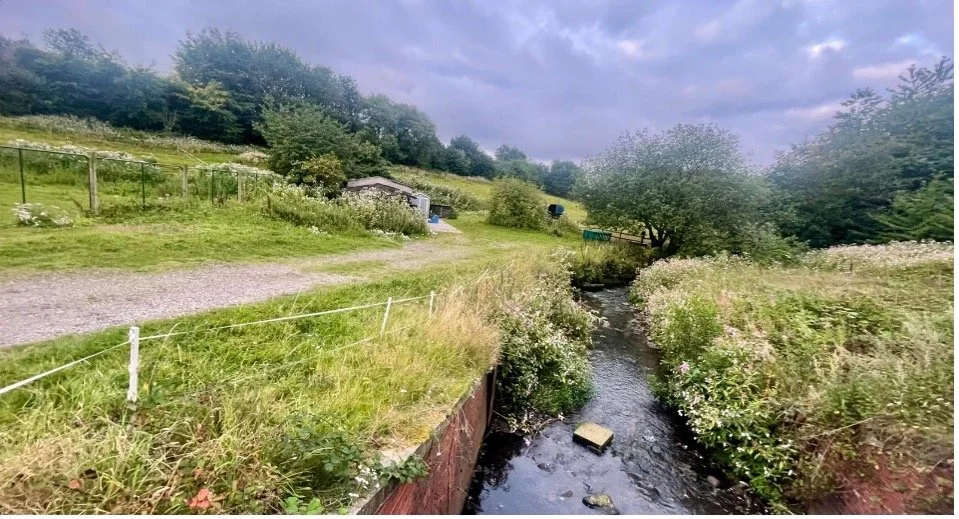
The piece is a sonic reflection on the River Irk in North Manchester - a waterway running through Harpurhey, one of England’s most economically marginalised suburban areas. This site is now at the centre of one of the North West’s largest regeneration projects, where new ‘Riverside’ apartments rise beside a river long overlooked and in need of care. The piece emerges from a durational listening practice that uses sound to explore how communities in social housing experience and respond to urban transformation. Captured through hydrophones and field recordings, the Irk becomes more than a backdrop - it speaks, pulses, and remembers. The river hums with industrial noise, bursts with surface disruptions, and carries histories of displacement and resilience. Rather than narrating change, the work invites a deeper sensory encounter with place. It gestures toward what some might call a liquid history: the way rivers hold memory in motion – where development plans intersect with lived experience, and where the overlooked details of water, voice, and vibration resist easy erasure.
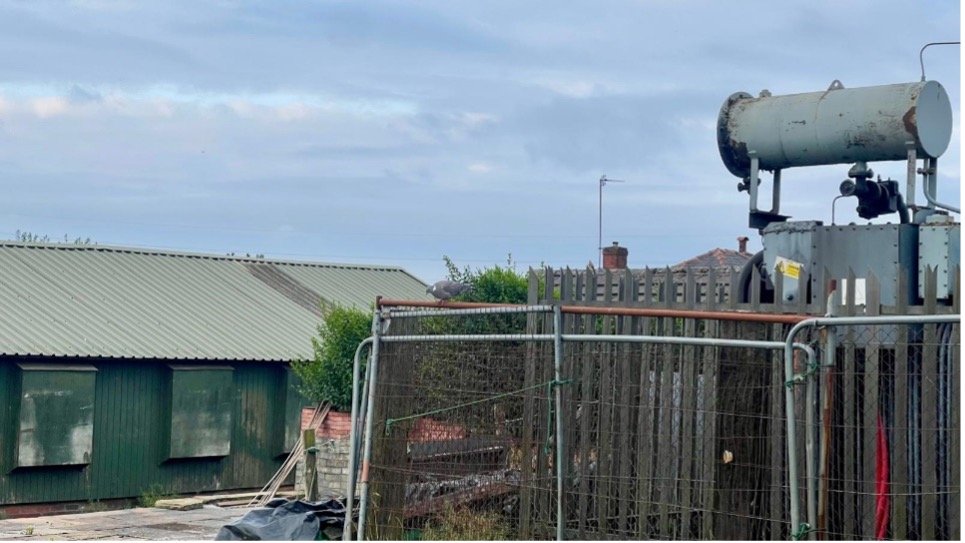
Two Worlds was reimagined on the banks of River Irk, in Manchester UK. On 13th August 2025, we stayed at a Travel Lodge beside the A627 Motorway near the source of the river, barely sleeping and waking before dawn to record nocturnal sounds and bird chorus rising with the sun. An eerie silence complemented darkness of branches as we recorded light appearing on water moving over rocks, watching manmade materials gathered in muddy crevices. As we walked on, morning engines stirred sleeping bodies in residential areas. Surprise roosters ran their beaks and local farm generators offered conversation. At some point, still before 6am, we began recording our thoughts, of two lively worlds present in our ears and recorders - the natural world on one hand, and the omnipresent sound of industry on the other. ‘It’s as though two worlds are happening, unaware that the other exists,’ we reflected.
The wonderful thing about long-term collaboration is its trusting nature. We don’t recall who said these words first, and how the title came to be. We simply know that a conversation was had in response to what we were experiencing, and listening to, within our environment. Two worlds made up of natural sounds of water, birds, trees moving with wind, and industrial sounds of cars, hums of machines and chattering silver materials.
This early August morning inspired us to make a piece that deliberately contrasts these sound-worlds against one another, attempting to build a musical sound collage from the beauty and intrigue of both. We selected moments from the recordings and sculpted the sounds we wanted, making loops and building chords from pitch-shifted material. The sounds are then placed through a computer-based ‘generative’ process, in which the computer decides which snippets of audio to play next, based on probabilities decided by us. The composition therefore generates itself, endlessly making new patterns from the audio we select. An everlasting, ever-evolving sound collage that mirrors the patterns and textures of rivers, varying from moment to moment, always moving, forming their own geology in walls and land, and leading us back to realisations of why we are here with this river to begin with. River Irk, running through areas undergoing rapid urban regeneration, in need of vital energy, of care, and creative (re)imaginings.
And so, you will hear recordings from this day, with voices of community members Fiona has been working with this past year, weaving in and out. Although you might hear the same sound or sentence more than once, they will never be repeated in the exact same way. Could it be, for this moment, that vital energy exists here? Listening together in this space.
Fiona Brehony and Simon Knighton, September 2025.
Live Performances of Two Worlds - University of Oxford AHRC Conference (Sept 2025); Islington Mill (Dec 2025)